
Demo Wall
Scottsdale Community College
While Austin and Lucas were looking to take a leak, they came across this demo wall. It showed a classic example of building science gone wrong and we asked to fix it.
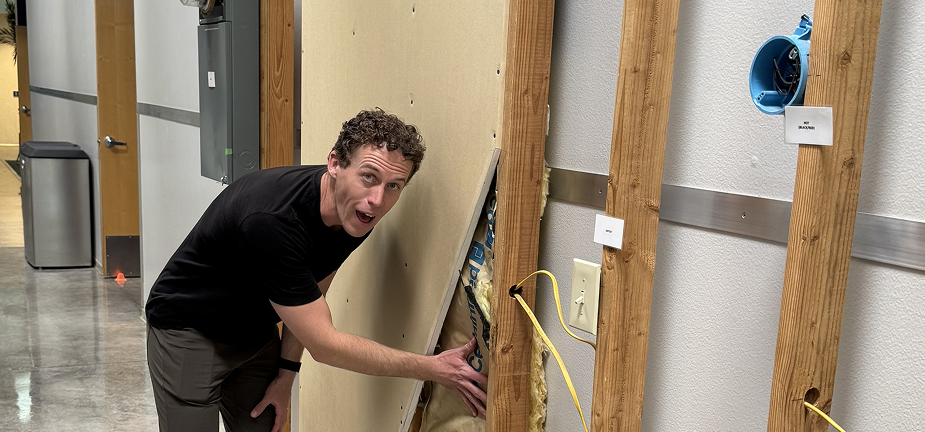
After some preparation, we came back:
Why It Needs Fixin'
The kraft paper facing was supposed to create some air control, and minimize water vapor movement into walls, but the performance wasn't sufficient and it was almost never installed to manufacturer's specifications; staple the kraft paper across stud bays and then tape over the studs to make it somewhat continuous.
Health: Fiberglass breaks down over time, which results in dust that makes you cough, itch, and potentially much worse.
Carbon: Fiberglass takes a lot of energy to harvest the materials and manufacture them into the final product, so it has a relatively large amount of embodied carbon.
Performance #1: Rated R-value is very different than a reality adjusted R-value. Due to the "gaps, voids, and compressions", and being poorly wrapped around electrical wires, the real world performance is at least 50% lower than the rated R-value.
Performance #2: Fiberglass is low density and made of glass, so it has poor thermal performance in Desert climates due to large diurnal temperature swings.
Bringing the Wall Into the 21st Century
Our Micro Mold Resistant Wall recipe is the modern-day incarnation of what fiberglass and kraft interior facing hoped to achieve. Wool looks kind of like fiberglass but nature's fibers offer improvements in every area.
Health: Havelock Wool captures toxins instead of releasing them, improves humidity levels by buffering moisture, and no itchy skin while installing.
Carbon: Havelock wool is a waste product of the wool industry, and it is a renewable resource.
Performance: Vapor Variable Membrane achieves what kraft interior facing hoped to. A more precise vapor profile that adapts to seasons and keeps walls dry along with absolute airtightness and a less fussy install.